

Automated Guided Vehicle Factory Innovations Driving the Next Era of Material Handling
2026-08-27
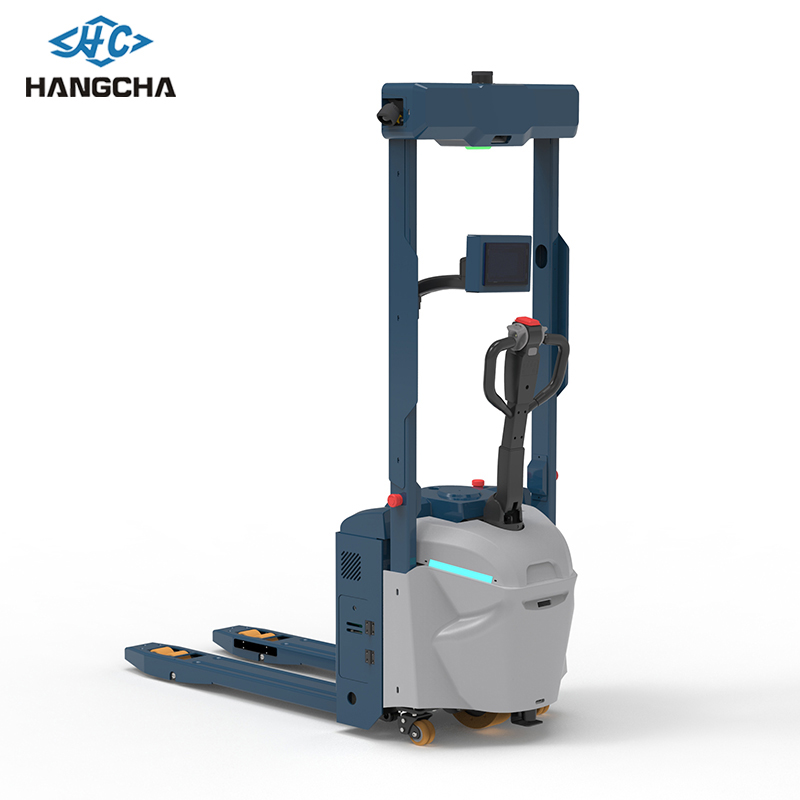
Most conversations about automated guided vehicles stop at the warehouse door. But the real revolution starts earlier—on the factory floor where these machines are born. Here, welding robots calibrate chassis to sub-millimeter accuracy, and software is flashed onto drive units before they ever touch a pallet. It is a level of precision that directly affects uptime, load capacity, and safety in the field. HANGCHA has been quietly leading this shift, turning its own manufacturing innovations into AGVs that handle real-world complexity with less noise and more control. The next era of material handling is being built one automated line at a time.
Adaptive Navigation: Teaching AGVs to Read a Factory Like a Living Map
Adaptive Navigation isn't about giving AGVs a fixed route and hoping for the best. It treats the factory floor as a living map, one that shifts with every pallet drop, every forklift detour, and every temporary work zone. The vehicles learn to read those changes the way a seasoned driver reads traffic, not by memorizing signs but by sensing patterns and adjusting on the fly.
What makes this approach different is the focus on local cues over global coordinates. Instead of relying solely on a preplanned layout, each AGV builds a short-range understanding of aisle widths, floor markings, and even the subtle wear patterns that reveal where humans tend to walk. That lets them slow down near blind corners, reroute around a spill that hasn't been logged yet, or nudge a few centimeters to avoid a low-hanging beam.
The result is a fleet that behaves less like a train on rails and more like a group of attentive coworkers. Maintenance teams stop needing to update maps every time a rack moves. Production planners see fewer stall alerts. And the AGVs themselves end up logging the kinds of micro-adjustments that, over time, make the whole system feel less like automation and more like adaptation.
Sensor Fusion at Work: Precision That Outperforms Human Instinct
On a modern assembly line, a robotic arm places a microchip onto a board with a tolerance measured in micrometers. Its confidence doesn't come from a single camera or a torque sensor. It comes from the quiet conversation between a dozen inputs—vision, lidar, inertial measurement, force feedback, even temperature—merged in real time. When one sensor misreads a glint of light or a momentary vibration, others correct the interpretation before the arm moves. The result is a level of repeatability no human hand could match, not because people are careless, but because our senses weren't designed to resolve microns at high speed.
That same principle shows up in vehicles that brake for a pedestrian before the driver's foot leaves the accelerator. Radar might spot the shape through fog, while a camera confirms it's a person and an ultrasonic sensor judges closure speed. Individually, each signal is incomplete; fused together, they create a model of the world sharp enough to act on in milliseconds. Human instinct is remarkable, but it can be fooled by poor visibility or divided attention. Sensor fusion doesn't get distracted, and it doesn't second-guess a pattern across eight data streams.
What makes the fusion practical is not raw data volume but disagreement. A well-designed system treats conflicting sensor readings as information rather than noise. If an accelerometer says the robot is tilting while a gyroscope says it's stable, the mismatch can reveal wheel slip or a mounting fault. By resolving those conflicts on the fly, the system develops a certainty that feels almost intuitive—yet it's built from math, timing, and redundancy, not from gut feeling.
The Quiet Choreography of a 200-Strong AGV Fleet
On the warehouse floor, two hundred AGVs trace overlapping paths with a restraint that feels almost deliberate. There are no shouted instructions or flashing dispatch boards; only the faint whir of electric drives and the occasional click of a lifting deck. Each machine reads painted floor codes and lidar returns, adjusting its speed in tiny increments to keep a 40-centimeter buffer from the next unit. The result is less like traffic and more like an unspoken agreement among strangers who have learned exactly how close they can get.
At intersections, the choreography grows more intricate. Instead of a central controller dictating every move, vehicles broadcast brief intent packets to nearby peers, then yield or proceed based on a priority that shifts with battery state and load urgency. A loaded pallet transporter might roll through first, while an empty unit waits an extra two seconds without complaint. Charging breaks happen the same way: a vehicle with a dipping cell bank peels off toward an induction pad, and another slips into its slot before the gap becomes visible to human eyes.
The quiet is not emptiness but a layer of coordination that refuses to call attention to itself. Forklift operators who once relied on horns and hand signals now share lanes with these machines, learning to read their subtle pauses and gentle detours. Over time, the fleet's near-silent negotiation becomes a kind of operational grammar, one that keeps 200 independent actors moving in parallel without a single raised voice.
Energy Without Anxiety: Powering AGVs Through the Longest Shifts
Most AGV fleets no longer rely on bulky lead-acid packs that need eight-hour cool-downs and a dedicated battery-swap room. The shift to lithium iron phosphate (LFP) and nickel manganese cobalt (NMC) cells means a 15-minute opportunity charge at a pick station can add another two hours of runtime. This changes the entire rhythm of a shift: the vehicle tops up while a pallet is being secured, not while the line is waiting.
The battery management system does the heavy lifting here, tracking cell temperature, state of charge, and load spikes in real time. Instead of a fixed charge schedule, it learns each route's energy cost and pulls vehicles off the floor only when the next idle window actually exists. In a three-shift warehouse, that can mean the difference between a fleet that needs three spare units per shift and one that runs with none.
Collaborative by Design: When AGVs and Workers Move as One
On the floor of a modern distribution center, the old rhythm of stop-and-go traffic is giving way to something more fluid. Automated guided vehicles no longer crawl along fixed magnetic tape, isolated behind safety cages. Instead, they thread through aisles where workers pick, pack, and pivot without breaking stride. The trick isn't just better sensors or faster processors—it's a shared understanding of movement. When an AGV slows to let a forklift pass, or a picker steps aside without looking up because the vehicle's path is already familiar, the boundary between machine and human blurs into a single choreography.
That choreography depends on predictability. A worker who has learned that an AGV will always yield at a corner can move around that corner without hesitation. The AGV, in turn, reads subtle cues—a hand gesture, a shifted cart, a momentary pause—and adjusts its speed by centimeters per second, not by emergency stops. This is not human-robot interaction as a set of rules, but as a kind of informal negotiation. Neither side dominates; both adapt. The result is fewer alarms, shorter cycle times, and a floor that feels less like a warehouse and more like a busy sidewalk where everyone knows the unwritten rules.
Achieving this level of integration requires more than automation. It demands a redesign of workflows around the idea of co-presence. Tasks are broken into micro-movements that can be handed off smoothly: the AGV positions a tote, the worker fills it, the AGV departs just as the next empty tote arrives. Success is measured not in meters per second, but in the absence of friction—no waiting, no double-handling, no startled pauses. When AGVs and workers move as one, the technology disappears into the background, and what remains is simply people getting things done with capable partners at their side.
Self-Aware Machines: Predictive Maintenance That Never Sleeps
A maintenance calendar based on hours of operation or calendar days is essentially a guess. Rotating parts wear at different rates depending on load, temperature, and contamination. When you schedule a teardown every 3,000 hours, you might replace a bearing that still had 40% life left — or you might miss one that started degrading at 2,100 hours and is now chewing into the housing. That’s not maintenance; that’s ritual.
Self-aware machines don’t follow a calendar. They build a baseline of their own normal operating signature — vibration spectra, thermal gradients, acoustic emission, even subtle changes in current draw. When a measurable pattern drifts outside its usual envelope, the machine flags it. Not as a generic check engine warning, but as something like bearing 3 on the outboard motor shows increased high-frequency vibration, likely inner race spalling; recommend inspection within 72 operating hours. That’s a diagnosis, not a guess.
The result is maintenance that happens only when needed, but before failure. No more midnight calls because a pump seized during a weekend batch. No more replacing perfectly good components on a schedule. And no more stockpiling every spare just in case. The machine is always listening to itself, even when nobody else is — which is exactly why it can sleep less than your team does.
FAQ
The current wave centers on smarter navigation and fleet coordination. Instead of fixed magnetic tape or simple laser reflectors, new AGVs use natural feature recognition and 3D vision to map their surroundings in real time. This lets them operate in busy, changing factory floors without predefined routes, while cloud-based fleet management software optimizes traffic flow and energy use across dozens of units.
They remove the rigid conveyor mindset. Modern AGVs act as mobile workstations that can dock with assembly lines, transport pallets, or deliver parts just-in-time. Because they can adapt to layout changes and scale up quickly, facilities can reconfigure workflows in days rather than months. This flexibility reduces bottlenecks and lets a single fleet serve multiple production areas.
A mix of edge computing, 5G connectivity, and AI-based perception is crucial. Onboard processors handle SLAM algorithms locally for low-latency obstacle avoidance, while 5G links synchronize large fleets and stream diagnostic data. Computer vision with deep learning allows AGVs to recognize objects, damaged pallets, or even hand signals from workers, making them safer and more autonomous.
Safety improves because AGVs no longer rely solely on zone scanners. Newer models fuse lidar, stereo cameras, and radar to detect obstacles in 3D and predict human movement. They can slow down preemptively near intersections or blind corners. Some systems also use digital twins to simulate traffic patterns and identify risky spots before the AGVs are even deployed.
The barriers are dropping. Lightweight, modular AGVs with subscription-based fleet software let mid-sized operations start with just two or three units and expand later. Since navigation is map-based rather than requiring extensive floor modifications, installation costs are much lower. Many vendors now offer retrofittable kits for existing manual carts, so smaller factories can automate step by step.
Integration with legacy systems is often the biggest hurdle. Existing warehouse management software may not communicate well with AGV fleet controllers, requiring middleware or API work. Change management also matters: workers need retraining to trust and interact with AGVs. Finally, network reliability is critical because a dead zone can halt the entire fleet, so Wi-Fi or 5G coverage must be carefully planned.
Efficiency gains directly reduce energy waste. Instead of running fixed conveyors 24/7, AGVs operate only when needed and use regenerative braking to recover power. Smarter routing lowers travel distance and battery drain. Some factories pair AGVs with predictive maintenance to extend battery life and swap lithium-ion packs less frequently, cutting both costs and environmental footprint.
Expect tighter integration with collaborative robots and automated storage systems. AGVs will become mobile manipulation platforms, not just transporters, as robotic arms get mounted on them for picking and kitting. Swarm intelligence will let vehicles negotiate directly with each other, and wireless charging embedded in factory floors could eliminate manual battery swaps entirely.
Conclusion
Across modern production floors, AGVs are being reengineered to think less like scripted carts and more like attentive partners. Adaptive navigation turns a facility into a living map, with vehicles updating routes around shifting pallets, blocked aisles, or sudden layout changes—no new tape or magnetic strips required. At the same time, sensor fusion blends lidar, vision, inertial data, and wheel encoders into a single confident read of the environment, catching details that human eyes might miss during a hurried shift. The real test arrives when two hundred of these machines share the same floor. Fleet orchestration software quietly resolves right-of-way in milliseconds, preventing bottlenecks before they form and letting each AGV slow, yield, or reroute without a central traffic cop shouting orders.
Powering these long, demanding runs no longer means anxious battery swaps. New energy strategies—opportunity charging, high-density cells, and smart power management—let AGVs match the rhythm of a triple shift without losing pace. And because humans still belong on the floor, collaborative design shapes the physical and digital behavior of each machine: rounded edges, predictable braking, and clear light signals make workers feel safe walking alongside. Underneath it all, self-aware diagnostics monitor bearing wear, wheel drift, and motor heat around the clock. Maintenance becomes a scheduled pause rather than a surprise halt, keeping the entire fleet moving as one quiet, coordinated organism.
Contact Us
Contact Person: Liuxue
Email: [email protected]
Tel/WhatsApp: +86-19084200370
Website: https://www.hf-ec.com/