China Textured Geomembrane Advantages for Durable Containment and Slope Stability
2026-11-27
When a liner fails, the problem is rarely the material alone—it’s the interface. Smooth surfaces can leave slopes vulnerable to sliding, but China textured geomembrane changes that equation. Its roughened profile grips ballast, soil, and cover materials, turning a simple barrier into a stable, load-bearing layer. That distinction matters for landfills, mining pads, and ponds where containment must hold for decades. In this post, we’ll unpack the advantages that make textured geomembrane a practical choice for durable containment and slope stability. For projects that can’t afford guesswork, JInseed Geosynthetics Solution supplies engineered geosynthetics built around these demands.
Why Texture Changes Slope Behavior
Snow texture is rarely just a visual detail; it directly sets the terms for how a slope grips, releases, and slides beneath a board or ski. Fresh powder may look uniform, but it is a loose collection of branched crystals that collapse and refreeze under pressure. That shifting contact layer can feel forgiving at low edge angles and suddenly grabby when a rider commits to a turn. The same pitch can behave like a completely different surface once those crystals are broken into smaller grains or pressed into a denser matrix.
Small weather shifts rewrite that texture within hours. Sunlight rounds the sharp edges of surface grains, while a cold night can grow a fragile crust of feathery hoar. A slope that felt secure in the morning may turn slick and unpredictable by early afternoon, not because the angle changed, but because the surface lost its fine-scale roughness. That roughness is what allows an edge to find purchase; without it, even a well-tuned edge can skate across the top instead of slicing into the snow.
Riders who adapt quickly tend to read these changes through their feet rather than treating texture as a fixed category. On coarse, grippy snow the feedback is immediate and the body can stay stacked over the board. On smooth, glazed surfaces the same movement can overload the edge before the rider feels the slip. Texture, in that sense, is less a background condition and more a constant negotiation between the slope and the line you intend to ride.
Containment Reliability When Ground Moves
Ground movement rarely announces itself in a uniform way. A tank pad may settle at one corner while a transfer line twists a few metres away, and in that mismatch the containment boundary starts working against itself. The failure often begins at the point where rigid and flexible elements meet—a weld, a flanged joint, a concrete-to-steel transition—because the local strain demands something the original geometry never assumed.
Reliability under those conditions is less about making a structure stronger and more about letting it move without losing the seal. That means choosing joint details that can tolerate angular rotation, isolating brittle coatings from substrate flexure, and keeping settlement tolerances tight enough that a liner does not fold or tear. It also means accepting that some movement will happen; the question is whether the containment can absorb it in a controlled way before strength becomes the last line of defence.
Field evidence adds a blunt reminder. After earthquakes and mining-induced subsidence, the most frequently reported breaches occur not through obvious wall collapse but through small openings at penetrations, sumps, and seams. Inspections that focus only on visible cracks miss the deeper problem. A reliable containment system is one where deformation is mapped, measured, and directed away from the seals that matter most.
Friction Performance in Wet and Dry Cycles
Brake friction rarely behaves the same way twice, and that becomes especially obvious when you move between wet and dry stops. A thin film of water acts as a temporary lubricant, delaying the moment the pad and rotor truly bite. In dry conditions, the same pairing can feel immediate and aggressive, with little to no ramp-up time. The real challenge isn't just measuring peak friction, but understanding how quickly the system recovers from that wet-state lag before it returns to a stable coefficient.
Repeated cycles reveal another layer of behavior. Some friction materials shed water quickly and recover within one or two stops, while others hold moisture in their surface pores and show a longer, less predictable recovery curve. Thermal cycling adds to this: a rotor that heats up during dry braking then gets splashed with water can develop uneven cooling, which shifts the friction distribution across the pad face. This isn't a simple wet-versus-dry switch, but a continuous variation in bite, modulation, and release feel.
What separates a well-tuned friction system from a mediocre one is how flat the performance stays across these changing conditions. Instead of chasing a single high number on a dry dyno run, it's more useful to look at the spread between wet initial bite and dry hot stop. A smaller spread usually means the driver can brake with confidence regardless of weather, while a large spread forces constant adaptation. That consistency, more than any single friction value, is what tends to show up in real-world driving and longer-term wear patterns.
Installation Details That Prevent Field Failures
Most field failures trace back to a handful of installation oversights that rarely show up on a checklist. Torque values pulled from memory, connectors seated just shy of the locking detent, and cables routed with a tight bend radius all seem acceptable at the bench. Vibration, thermal cycling, and moisture turn those small compromises into intermittent faults within months. Recording the actual torque applied to every fastener, rather than relying on feel, removes the most common root cause of loose terminations.
The difference between a reliable install and a callback often comes down to verifying what cannot be seen after the covers go on. A quick tug test on each crimp, a continuity check after final routing, and a photograph of the completed terminations create a record that outlasts memory. When installers follow a short, closed-loop verification step before signing off, rework drops sharply and failures linked to installation errors become rare.
Environmental sealing deserves the same attention as electrical connections. Glands tightened in the wrong sequence, unused entries left open, and gaskets pinched during reassembly invite moisture ingress that may not appear until the first heavy rain. Matching the sealing method to the actual exposure, and double-checking every entry point, prevents the slow corrosion that looks like a component defect but is really an installation gap.
Long-Term Durability Beyond Laboratory Aging
Accelerated weathering chambers compress ultraviolet exposure, humidity, and thermal cycling into a few thousand hours, but they still struggle to reproduce how those forces arrive together outdoors. A material can sail through a standard laboratory aging protocol and then lose its gloss or crack at a corner after several seasons of real sun, wind-driven rain, and overnight frost. The mismatch is not a flaw in testing as much as a limit: controlled cycles isolate variables, while field exposure delivers them all at once and rarely in the same order.
Durability beyond the lab usually shows up in the details that accelerated programs overlook. Edges, fasteners, joints, and places where water lingers tend to fail first, regardless of how well a flat coupon performs under a xenon lamp. That is why long-term case histories matter more than a single score from an aging cabinet. When installations in coastal, high-altitude, or freeze-thaw climates retain their appearance and adhesion after a decade or two, the evidence begins to speak for the formulation and the application rather than for the test chamber.
Field inspections over fifteen or twenty years tend to reveal the same weak points: cut edges, transitions between materials, and areas where rainwater collects. Watching a system hold up in those vulnerable spots, across different climates, gives a more honest read on longevity than any accelerated cycle. It also shows whether early signs of wear remain cosmetic or start to threaten adhesion and protection.
Matching Textured Patterns to Real Site Demands
Texture selection often falls apart when it ignores how people actually move through a space. A raised stone pattern may look impressive in a catalog but becomes a tripping hazard on a sloped walkway after rain. Before choosing any textured surface, map the real traffic flow, exposure to moisture, and maintenance schedule. A busy lobby needs a pattern that hides scuffs without turning slippery under wet shoes, while a quiet courtyard can afford a more delicate relief that invites touch.
Site-specific demands also shape the scale and direction of a pattern. Large geometric reliefs can overwhelm a narrow corridor but bring rhythm to an open plaza. Pay attention to how natural light hits the surface at different hours; deep grooves cast strong shadows that may flatten or exaggerate the intended effect. In shaded areas, subtle texture may disappear entirely, so contrast and depth need to be tested on-site rather than assumed from a sample board.
Durability is not a separate conversation from aesthetics. A textured wall near an entrance will collect dust in its recesses, demanding frequent cleaning that erodes fine detail over time. Match the pattern's resilience to the real abuse it will face: high-contact zones benefit from broader, shallower relief, while protected vertical surfaces can carry finer, more intricate work. The strongest choices come from walking the site, noting where hands, carts, or weather will repeatedly interact with the surface, and letting those observations drive the pattern decision.
FAQ
The raised surface creates friction against soil, geotextile, or drainage stone, which helps keep cover materials from sliding. That added grip allows designers to use steeper slope angles without relying solely on toe berms or benches.
When texturing is done during extrusion rather than applied as a separate layer, the sheet keeps its thickness and stress crack resistance. The surface profile does not reduce chemical resistance, and the liner remains flexible enough to handle settlement without losing containment.
Yes, many Chinese manufacturers run modern flat-die and blown-film lines with full quality control. The key is to check resin specifications, carbon black content, oxidation resistance, and independent test reports rather than relying on price alone.
Landfill caps and base liners, heap leach pads, tailings ponds, and reservoir slopes all benefit. Each case has a sliding or veneer stability concern, and the texture gives extra interface shear strength where a smooth liner would need a flatter slope or additional soil cover.
It changes the welding setup, but it does not have to lower seam quality. Weld technicians normally clean the textured area, adjust wedge temperature and speed, and run trial seams. Once parameters are set, peel and shear values are usually comparable to smooth geomembrane.
They should request full-thickness samples, confirmed resin type and density, consistent asperity height, carbon black dispersion, tensile and puncture data, OIT for oxidation resistance, and third-party testing from an accredited lab. A factory audit also helps verify that daily production controls match the submitted certificates.
It generally handles rough contact better than thin smooth sheet because the textured layer adds a small amount of surface toughness. The subgrade still needs to be free of sharp stones or roots, and a geotextile cushion is often used where puncture risk is high.
Conclusion
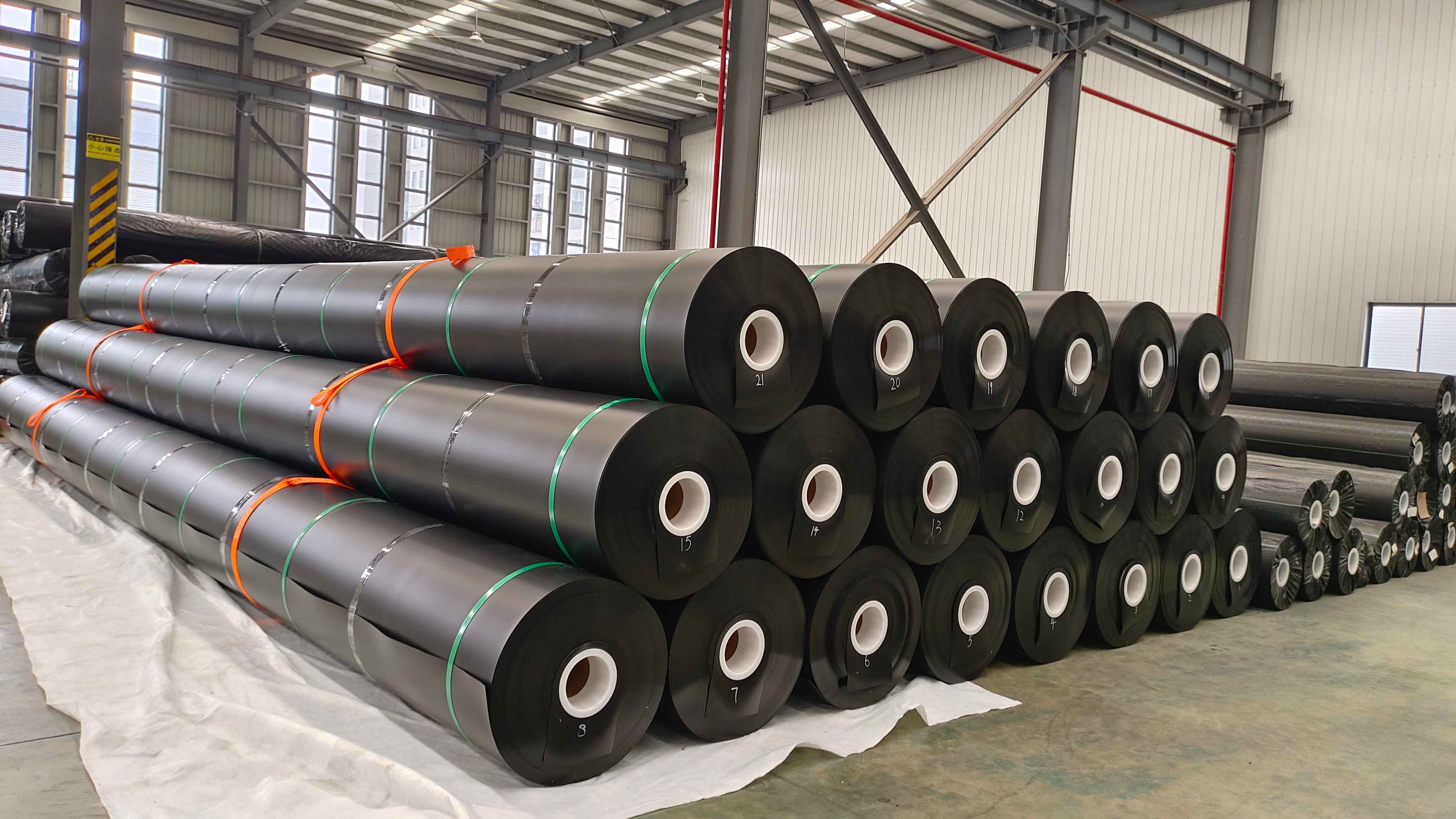
Texturing on Chinese geomembranes does more than add surface roughness; it alters how loads transfer across the liner interface. On steeper slopes, the asperities interlock with overlying geotextiles or soils and limit progressive slippage before it begins, which is a different failure pattern from smooth sheet. Repeated wetting and drying often reduces interface friction in traditional liners, but properly formed textured surfaces retain much of their grip because the drainage channels between asperities prevent continuous water film buildup. When minor settlement or lateral ground movement occurs, that same interlock permits small differential strains without tearing or pulling the liner out of anchor trenches, helping the containment system stay intact under conditions that would otherwise concentrate stress at seams.
Field performance still depends on installation choices that laboratory tests rarely capture. Weld windows, surface cleanliness, subgrade preparation, and anchor trench backfilling often decide whether a specified textured sheet performs as intended. Chinese manufacturers have responded with patterns that vary in asperity height and density for single- or double-sided applications, allowing designers to match the texture to the actual slope angle, cover material, and hydraulic load rather than relying on a generic product. Long-term durability claims are increasingly tied to stress crack resistance, antioxidant retention, and low-temperature flexibility rather than short oven aging alone. When the right pattern is paired with careful seaming and deployment, the result is a liner that maintains both containment and slope stability without overdesign or unnecessary cost.
Contact Us
Contact Person: Jerry Qiu
Email: [email protected]
Tel/WhatsApp: +65 84265294
Website: https://jinseed-geo.com