

China Type B RCD Essentials for Safe EV Charging and Industrial Use
2026-08-23
Every EV charger and industrial motor drive hides a risk most AC-type RCDs were never designed to catch: smooth DC fault current. That’s exactly why China’s Type B RCD requirements are tightening across charging stations, factories, and commercial sites. Waiting until a fault appears is not a strategy. ETEK has been at the front of this shift, engineering Type B residual current protection that handles both AC and pulsating DC leakage without nuisance tripping. In this post, we break down the essentials—so you can spec, install, and operate with confidence.
Why a Type B RCD Is Non-Negotiable for Modern EV Charging
Type A and AC residual current devices were built for a different era of electrical loads. They trip on sinusoidal AC leakage, but the inverter and rectifier stages inside an EV charger can push a smooth DC fault current into the circuit. That current can blind a standard RCD, leaving the breaker mechanically closed while the ground path carries a live fault. If the vehicle's insulation degrades or a cable gets damaged, the result is not just nuisance tripping; it's a protection gap that ordinary test routines won't expose.
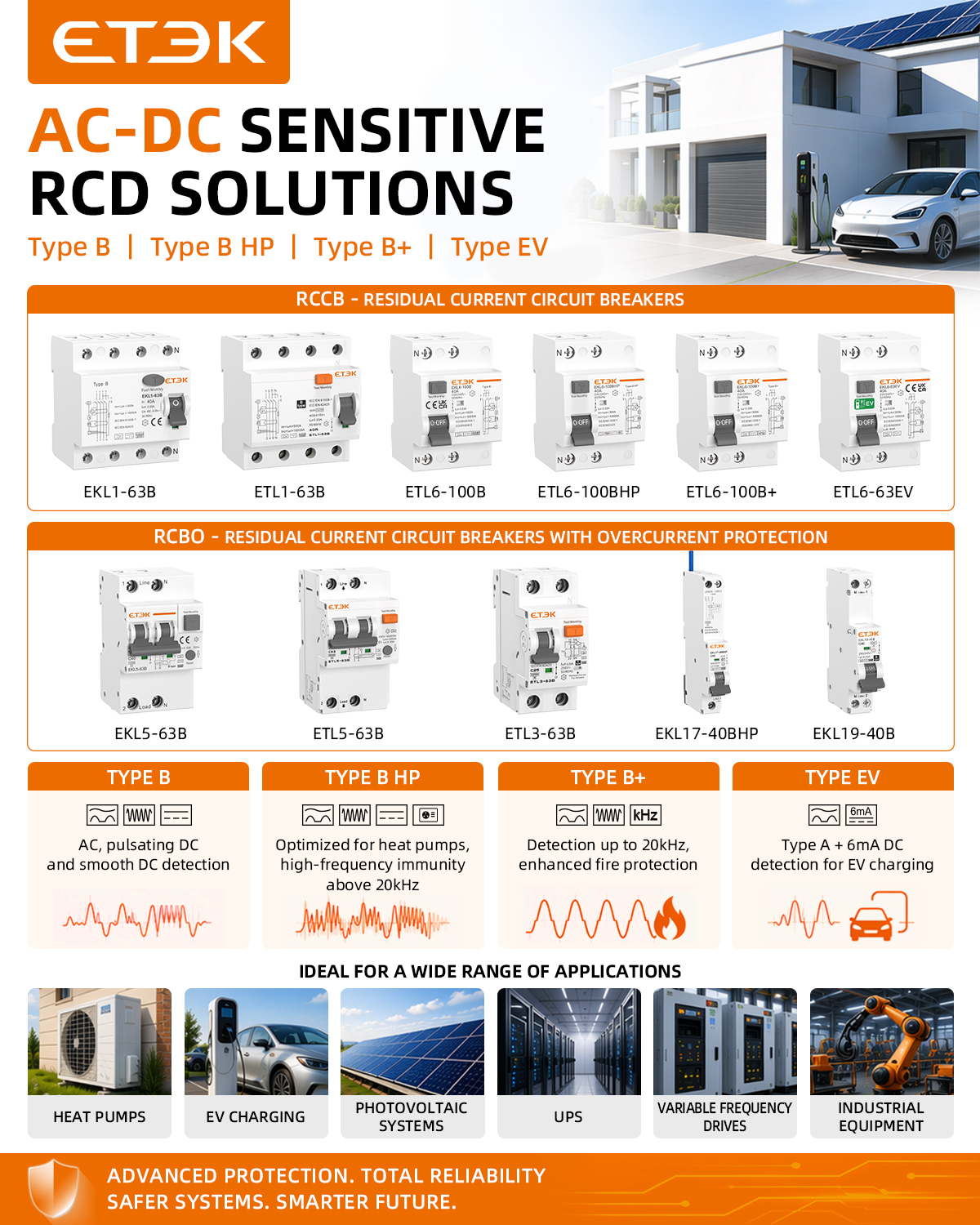
A Type B RCD is designed to see what the others ignore. It monitors AC leakage, pulsating DC, and smooth DC residual currents, so it reacts regardless of where the fault originates inside the charging chain. Modern wall boxes and charging stations frequently embed DC-sensitive residual current monitoring, but that doesn't make an upstream Type B optional. If the charger's internal detection fails, goes offline, or is bypassed, the circuit breaker becomes the last line of defense. Relying on a Type A device at that point is like trusting a smoke alarm that doesn't detect electrical fires.
The practical difference shows up in specifications. Installers may be tempted to save money by pairing an EV circuit with a Type A RCD plus a separate DC leakage detector, and some manufacturers allow it. But that setup adds a second point of failure and often requires a specific breaker-detector combination to work correctly. A single Type B RCD removes that complexity and gives the circuit a native response to DC faults. For a load that can sit charging overnight in a garage or driveway, the extra cost is trivial compared with the cost of a protection device failing exactly when it's needed.
How China's Wiring Rules Shape Residual Current Protection Choices
In China, the national wiring standards do more than just dictate cable colors and conduit sizes—they quietly steer the selection of residual current devices (RCDs) in ways that often surprise outside engineers. The core requirement stems from GB 50054 and related codes, which mandate RCD protection not only for socket outlets but also for circuits in wet locations, outdoor installations, and temporary site power. However, the practical choices go beyond a simple 30mA trip rating. Designers must account for the widespread use of TT and TN-C-S earthing systems, the unpredictability of older urban distribution networks, and the fact that many residential panels still lack dedicated protective earth conductors in legacy buildings. This means that a 'standard' Type AC RCD, common in many countries, can be dangerous or non-compliant in parts of China where DC leakage from variable-frequency drives, EV chargers, or modern LED lighting is present. The wiring rules effectively push consultants toward Type A or even Type F RCDs, especially in commercial and industrial settings, while also demanding careful attention to discrimination and tripping times under fault conditions unique to densely loaded low-voltage grids.
Another layer of influence comes from the wiring rules' treatment of neutral and protective conductor separation. In TN-C-S systems, the point where the PEN conductor splits into PE and N is critical, and any RCD placed upstream of that split will not function correctly. Chinese codes explicitly require that RCDs be installed downstream of the separation point, which in turn shapes how distribution boards are laid out and where main switches versus branch circuit protection are placed. Moreover, the mandated use of 4-pole RCDs for three-phase circuits with neutral in many commercial installations is not just a preference—it is a direct consequence of the wiring rules' insistence on isolating all live conductors, including the neutral, under fault conditions. This differs from some European practices where 3-pole RCDs are accepted. The wiring rules also specify minimum insulation resistance values and maximum earth fault loop impedance, which indirectly determine what sensitivity and breaking capacity an RCD must have. A circuit that passes the loop impedance test with a 30mA RCD might still fail with a 100mA device, so the choice is often dictated by the calculated touch voltage limits in the specific installation.
Finally, the human factor in China's wiring regulations cannot be ignored. Enforcement varies widely between major cities like Shanghai and Shenzhen and smaller inland towns, leading to a market where RCD selection is often a compromise between code compliance and real-world supply chain availability. Many electricians still default to Type AC RCDs because they are cheaper and widely stocked, even when the written rules would demand otherwise. But as more local design institutes adopt strict interpretations of GB 51348-2019 for civil buildings, the pendulum is swinging toward mandatory Type A RCDs for all socket circuits in new residential projects. The wiring rules, in effect, are not just a technical document—they are a living reflection of China's rapid electrification history, its mixed legacy of earthing systems, and the ongoing tension between safety ideal and practical installation culture. Any engineer specifying residual current protection for a Chinese project must read between the lines of the code, understanding that the wiring rules shape not just what is required, but what is actually possible and accepted in the field.
DC Fault Currents: The Hidden Hazard in Industrial Motor Drives
Most drive technicians spend their careers watching for overvoltage trips and thermal overloads, but DC bus fault current rarely gets the same attention until it vaporizes a capacitor bank. In a typical industrial motor drive, the DC link sits between the rectifier and inverter stages, smoothing ripple and storing energy. When an IGBT fails short or a bus bar arcs over, the stored energy discharges in milliseconds, producing currents that can exceed normal operating levels by an order of magnitude.
The hazard is compounded by the fact that standard AC-side protection often cannot react fast enough. Fuses and circuit breakers rated for line-frequency faults may not clear a DC fault before semiconductor junctions reach destruction temperatures. Even drives with internal DC fuses can experience cascading damage if the fault impedance is low, because the inductance in the bus structure limits current rise only briefly. Field reports show that a single failed module can leave the entire drive section with welded contacts and cracked DC link capacitors.
Mitigation starts with acknowledging that DC faults are not rare edge cases. Proper bus bar spacing, fast semiconductor fuses sized specifically for DC interruption, and regular infrared inspection of capacitor connections reduce the likelihood of a catastrophic event. Where arc flash boundaries are calculated, DC bus energy must be included separately from the AC supply side. Ignoring this hidden hazard means accepting a predictable, expensive, and dangerous failure mode.
Preventing False Trips When Power Quality Gets Messy
Circuit breakers are designed to respond to actual fault currents, but distorted waveforms from harmonics, voltage sags, or transient spikes can fool sensitive trip units into thinking a short circuit exists. Instead of replacing breakers or disabling protection, technicians often find the real fix lies in adjusting trip settings within safe margins or installing filters to clean up the incoming supply. A quick look at the event log usually shows whether the trip was caused by a genuine overload or just a noisy line confusing the electronics.
Field experience shows that many nuisance trips happen when adjustable instantaneous or short-time pickup thresholds are set too close to normal operating peaks. Raising these settings a notch—while still staying below actual fault levels—can keep a motor start or capacitor switching from looking like a phase-to-phase fault. In older facilities, adding line reactors or isolation transformers ahead of sensitive breakers often calms things down without needing a full switchgear overhaul.
Another practical step is to coordinate trip delays so brief power quality disturbances don’t cascade into a full shutdown. A few cycles of ride-through can make the difference between a harmless voltage dip and a production line going dark. When the supply is chronically messy, though, the most durable solution is to address the source: detune capacitor banks, balance single-phase loads, or upgrade to breakers with better harmonic rejection rather than endlessly resetting the same tripped unit.
Quick Checks to Keep Your Type B RCD Working Between Inspections
Give the test button a firm press every few weeks and watch how the mechanism responds. A healthy Type B RCD should trip cleanly without hesitation, cutting the circuit with a solid click rather than a sluggish or partial break. If the lever feels sticky, needs multiple pushes, or only trips after a worrying delay, that's a red flag worth noting before the next formal inspection.
While you're near the unit, run a quick visual sweep. Look for discolouration around the terminals, any faint burning smell, or fine dust caked inside the vents. These units handle complex residual currents, including smooth DC components, so their internal components run warmer than standard types. A casing that feels unusually hot to the back of your hand, or signs of moisture creeping in around the cable entries, can hint at insulation breakdown long before a fault current appears.
Don't forget the environment around the RCD itself. Vibration from nearby machinery, condensation in damp plant rooms, or even loose mounting screws can gradually shift internal calibration. Give the housing a gentle nudge—if it rattles or rocks in its DIN rail slot, reseat it firmly. A stable, dry, well-ventilated spot keeps the sensing coil and trip mechanism working predictably between scheduled checks.
Matching Protection Ratings to Charger Output Without Overspending
The real question isn't how much protection a charger has, but how much protection your situation demands. A 100W gallium nitride charger with a fully sealed, dust-proof housing sounds like a smart buy until you realize it will sit on a desk, far from moisture and grit. That extra money goes toward a rating you'll never need.
Match the output first. Look at what your phone, laptop, or tablet actually draws—most modern devices negotiate their own voltage and current, but the charger's maximum output should cover the highest draw without being wildly excessive. A 30W device doesn't benefit from a 140W brick, and the extra headroom often comes with a higher price and a bulkier enclosure.
When you do need outdoor or workshop charging, an IP54 or IP65 rating makes sense, but think about your specific exposure. Splash resistance is different from full submersion, and paying for IP68 when occasional rain is the only threat is overspending. Pair the protection level with the actual environment, and you'll end up with a charger that fits both your device and your budget.
FAQ
Many EV onboard chargers can produce a smooth DC residual current under fault conditions, which older Type AC or Type A devices simply cannot detect. A Type B RCD senses AC, pulsating DC, and smooth DC leakage, so it keeps the charging point from becoming a silent hazard.
Type AC units respond only to sinusoidal AC leakage, while Type A adds detection for pulsating DC. Type B goes further by also covering smooth DC and higher-frequency residual currents, which makes it suitable for converters, rectifiers, and EV charging electronics that can blind the other types.
Updated national codes for electric vehicle conductive charging, such as the GB/T 18487 series, now steer installers toward Type B or equivalent protection wherever DC leakage can occur. Industrial switchgear standards also reflect this shift as more rectifier-based equipment appears on factory floors.
Any setup with variable frequency drives, UPS systems, servo motors, or large rectifier banks can leak smooth DC current that saturates a Type A device. In those panels, a Type B RCD prevents false tripping or total failure to trip, which is why it is often the only sensible choice.
This is not a DIY swap. A licensed electrician needs to verify the earthing system, calculate background leakage from the connected equipment, and match the RCD's rated current and sensitivity to the circuit. The neutral and phase routing also differs from older installations, so a quick visual check is never enough.
Look beyond the brand. The rated residual operating current, rated load current, number of poles, short-circuit withstand rating, and ambient operating temperature all affect whether the unit will hold up. For personal protection, a 30 mA trip threshold is common, while fire prevention often uses 300 mA.
Yes, they deserve a bit more attention. In addition to the regular push-button test, a proper DC residual current injection test should be done at least once a year or as the manufacturer recommends. Check terminal torque, signs of moisture, and any dust buildup inside the enclosure at the same time.
Conclusion
In China's fast-evolving charging landscape, Type B residual current devices have shifted from a specialty option to a baseline requirement. The non-negotiable status stems from the fact that modern EV chargers and industrial motor drives generate smooth DC residual currents that can blind a standard Type AC or Type A RCD. A Type B unit responds to AC, pulsating DC, and smooth DC leakage, which is exactly what a charger's rectifier stage or a variable frequency drive can produce under fault conditions. China's wiring rules increasingly align with this reality, pushing designers to account for the full spectrum of residual current waveforms rather than relying on legacy assumptions. The hidden hazard in industrial motor drives is particularly acute: a DC component can saturate a conventional current transformer and prevent tripping altogether. That silent failure mode leaves equipment and personnel exposed, making Type B selection less about compliance and more about closing a genuine safety gap.
Real-world installations, however, are seldom textbook-clean. Poor power quality, harmonics from nearby equipment, and transient surges can conspire to cause nuisance tripping. A well-chosen Type B RCD with appropriate filtering and immunity characteristics keeps protection in place without turning every voltage dip into a false alarm. Between formal inspections, simple routine checks matter: verifying the test button response, confirming connections stay tight, and watching for any signs of moisture ingress or overheating in the enclosure. Matching protection ratings to charger output also demands a close look at actual load profiles rather than blanket oversizing. Selecting a 30 mA trip threshold for personnel protection and higher ratings for equipment circuits avoids paying for unnecessary headroom while still meeting operational safety. By pairing informed product choice with sensible maintenance habits, facility teams can keep EV charging and industrial motor applications both safe and financially sensible without overengineering.
Contact Us
Contact Person: Andy
Email: [email protected]
Tel/WhatsApp: +86 13356133008
Website: https://www.etek-china.com/