

Film Sandpaper Factory: Inside Precision Abrasive Manufacturing
2026-10-02
Step onto the floor of a film sandpaper factory and the first thing you notice isn’t the machinery—it’s the tension between grit and precision. Every roll that leaves SHENZHEN SUN ABRASIVES passes through a process where coating thickness is measured in microns and backing tension is tuned like an instrument. This isn’t bulk sandpaper; it’s engineered surface control, and it starts long before the abrasive grain meets the film.
Why Film Backing Outperforms Paper in High-Heat Sanding
Paper backings fall apart quickly under high-heat sanding. The friction from aggressive grits can scorch the paper fibers, making them brittle and prone to tearing at the edges. Once that happens, the disc stops tracking flat and starts gouging the surface. Film backing, typically polyester, doesn't char or lose tensile strength at the same temperatures. It stays flexible but tough, so the abrasive keeps cutting evenly without the backing breaking down first.
Adhesion is another weak point for paper. The glue holding the abrasive grains to paper softens as heat builds, causing grains to shed well before they're dull. Film backing offers a more stable, non-porous surface that bonds better with high-temperature resin systems. The result is slower grain loss and a more consistent scratch pattern over the life of the disc, even when you're leaning hard on a high-speed sander.
Film also wins on dimensional stability. Paper absorbs moisture from the air and expands or warps when heated, which can create wavy edges and uneven pressure. Film backing remains flat and dimensionally stable under heat spikes, so the abrasive interface stays uniform. That matters most in automotive clear coat work or metal finishing, where a wavy disc leaves deeper random scratches that are hard to buff out.
How Electrostatic Coating Keeps Every Grit Pointed Up
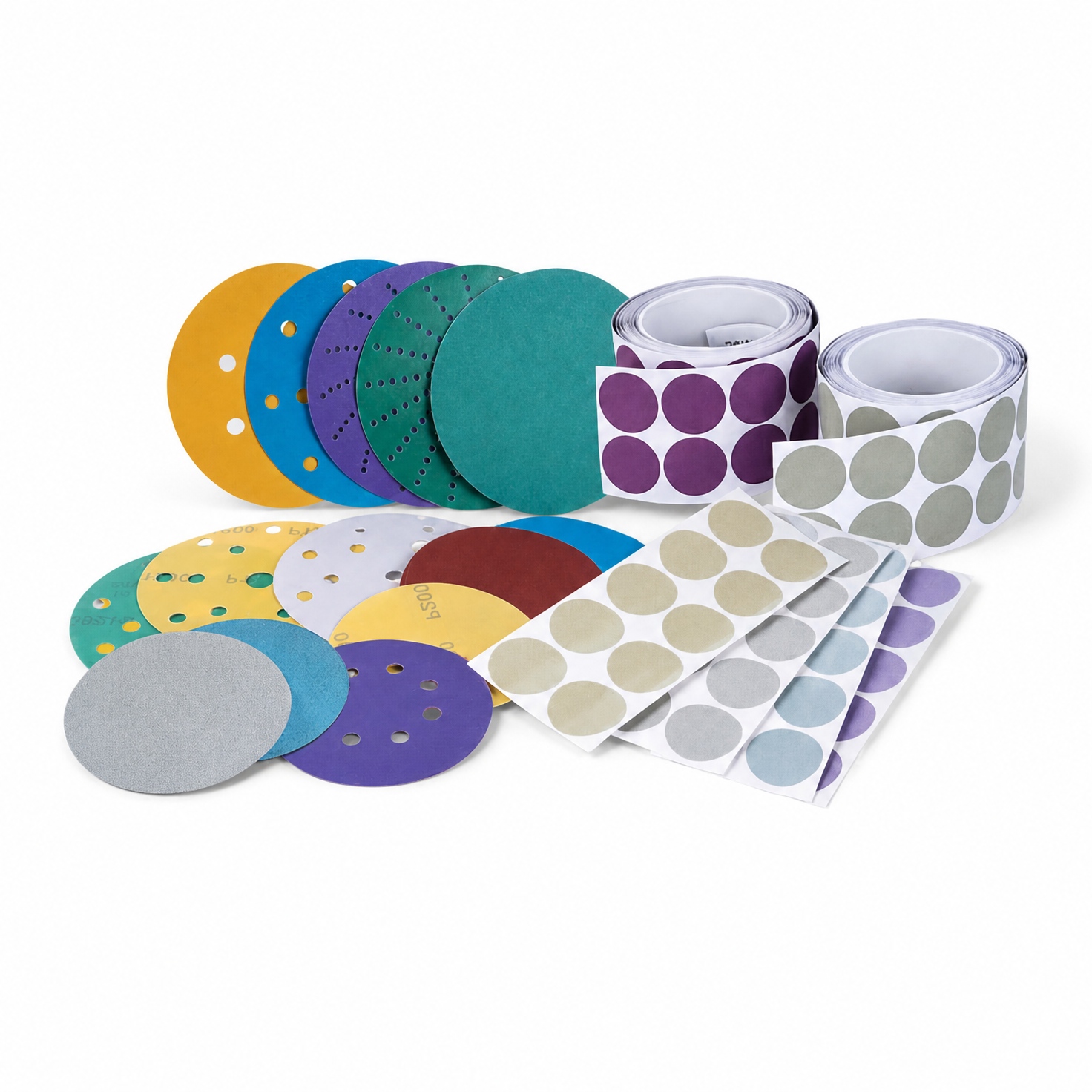
On a production line, the abrasive grains get a negative charge while the backing material carries a positive ground. The moment they meet, each particle flips into alignment with its long axis perpendicular to the surface. That puts the sharp tip into the adhesive layer and leaves the broader base exposed, which would be exactly backwards if the grains simply fell under gravity.
This upright arrangement isn't just cosmetic. It means the cutting points project above the resin bond instead of being smothered by it, so a fresh belt bites into the workpiece right away. The spaces between upright grains also give dust and debris a clear path to escape, preventing the surface from glazing over during longer sanding runs.
Fine-tuning the electrostatic voltage and the distance between the applicator and the backing lets manufacturers adjust how densely the grit stands up. The result is a coated abrasive that removes material more consistently, wears evenly, and doesn't require extra pressure to get started.
The Resin Formula That Prevents Loading on Soft Woods
Soft woods like pine, cedar, and spruce have an annoying habit of clogging abrasives the moment you start sanding. The usual fix is to swap out paper every few minutes, but a thin coat of a specific resin blend changes how the surface behaves. By sealing the earlywood pores before sanding, the resin keeps the fibers from gumming up the grit.
This particular formula mixes a low-viscosity epoxy or a shellac-based sanding sealer with a small amount of alcohol to help it penetrate quickly. Brushed on and left to flash off for twenty minutes, it hardens just enough to stiffen the fuzzy grain without creating a plastic-like skin. You can still feel the wood, but the paper now cuts cleanly instead of loading up.
Many woodworkers skip this step because it seems like extra work, yet it saves time overall. One resin application replaces three or four disc changes on a random-orbit sander. For anyone shaping softwood carvings or prepping pine trim, the trick turns a frustrating job into a much smoother pass.
Inside the Curing Ovens Where Temperature Never Wavers
Step into the heart of the curing line and you'll notice something almost unsettling: the air doesn't move the way you expect. No hot gusts, no cool pockets near the door seals. The ovens here run on a feedback loop so tight that the digital readout might as well be painted on. A batch of composite panels spends exactly forty-seven minutes at 312°F, and if a single burner flickers, the system compensates before the sensor can even register a dip. Operators don't hover over dials anymore—they trust the chamber like a metronome.
What makes this steadiness possible isn't a heavier heating element or thicker insulation. It's the way air is forced through a series of baffles that break turbulence into laminar sheets, then re-blend it at the exit before recirculation. Every fifteen seconds, a robotic arm passes a calibrated thermocouple through a sampling port, and the data feeds a predictive model that adjusts gas flow for the next cycle. The result is a temperature envelope so flat you could balance a coin on the curve. For coatings that cure by a narrow chemical window, that kind of repeatability means the difference between a finish that lasts a decade and one that peels in six months.
Walk along the catwalk above the line and you'll hear a low, even hum—not the roar of combustion, but the whisper of fans holding a ±1.5°F band across a forty-foot span. Night shifts run quieter than day shifts, not because the process slows, but because operators have learned that the ovens don't need supervision. They need only a glance at the trend chart, which for the past eleven days has looked like a straight line drawn with a ruler. That's the quiet achievement of modern curing: not heat, but certainty.
Tensile Tests and Tear Checks Before Any Roll Leaves
The inspection bench sits at the end of the production line, and no roll moves past it without a pair of material samples being cut from the outer wrap. A technician loads each strip into a universal testing machine, clamps it, and runs a slow, steady pull until the fabric either reaches its specified elongation or snaps. The reading gets logged against the roll's batch number, not just as a pass/fail flag but as a curve that shows exactly where the material gave way.
Tear checks follow a different rhythm. A small nick is made at the edge of a second sample, then the jaws pull apart at a fixed speed to see how far the tear travels and how much force it takes to keep it moving. Older lots sometimes tear clean; fresh production can fight back in a ragged line. That difference gets noted on the same sheet, because a roll that stretches fine but tears too easily won't survive a field repair.
If either number falls outside the band set for that product line, the entire roll gets quarantined and rerun through the same two stations after reconditioning. It slows the shift down, but nobody argues with the logic: a weak roll shipped today becomes a callback tomorrow, and the cost of replacing it is higher than the twenty minutes spent on the bench.
Custom Slitting for Odd-Shaped Profiles and Tight Corners
Odd-shaped profiles rarely respond well to standard slitting setups. When a workpiece has sharp notches, deep recesses, or contours that double back on themselves, the strip path loses uniformity and blade engagement becomes uneven. Instead of forcing a straight-line feed, we map the coil’s geometry first and adjust the slitting head position, entry guides, and scrap removal paths to match the actual profile. This keeps the cut line consistent even where the edge radius drops below 0.5 mm or the flange width changes mid-run.
Tight corners introduce a different problem: the material wants to tear or stretch ahead of the blade. We counter that by shortening the free span between the pinch point and the cut point, and by running narrow slitting arbors that can follow the profile without colliding with adjacent bends. For acute angles, we often switch to a staged cut—rough notch first, then a finishing pass—so the corner doesn’t pull the strip offline or leave a rolled burr.
The result is a slit edge that holds position within a few thousandths of an inch, even on parts with asymmetrical flanges or multiple bend lines. Because the setup is built around the part’s actual contour rather than a coil width, there’s less hand trimming and fewer secondary operations downstream.
FAQ
Film backing is polyester-based, dimensionally stable, tear-resistant, and holds abrasive grains more uniformly. It doesn't curl or degrade when wet, making it ideal for precision finishing.
Uses electrostatic coating to align abrasive grains perpendicular to backing, combined with automated optical inspection for micron-level thickness consistency.
Automotive paint finishing, electronics polishing, aerospace composite surface prep, and medical device manufacturing demand tight tolerances.
Temperature and humidity are regulated to prevent static and clumping; cleanroom-grade filtration removes dust that could create scratches.
Yes, film backing resists water and solvents, allowing wet sanding for cooler cutting and reduced loading on paints, primers, and clear coats.
Application engineers run trials on customer substrates, adjusting grain type (alumina, silicon carbide, ceramic), bond resin, and backing thickness.
Each roll is tested for grit size distribution, tear resistance, coating adhesion, and surface defects under high-intensity lights.
The tough film resists folding and creasing, so abrasive grains stay bonded at edges, reducing random deep scratches during hand sanding or machine sanding.
Conclusion
At a film sandpaper factory, the move away from paper backing is driven by high-heat sanding demands. Film resists softening and tearing when friction builds, so the abrasive stays flat against the workpiece far longer. Electrostatic coating plays a quiet but critical role: each grit particle is charged and pulled upward into the adhesive, locking it in a sharp, upright orientation instead of letting it lie flat or clump. Then a carefully tuned resin formula steps in, especially for soft woods like pine or cedar, where dust and sap would otherwise pack the spaces between grits. The resin's open structure sheds that debris, keeping the cutting edge clean and reducing downtime for cleaning or disc changes.
Further down the line, curing ovens maintain a narrow temperature band because even a few degrees of drift can leave the resin brittle or gummy, compromising the bond between film and abrasive. Once cured, every roll passes through tensile and tear testing—samples are stretched and ripped to confirm the backing won't fail under aggressive hand or machine sanding. Finally, custom slitting transforms wide master rolls into narrow strips, angled shapes, and profiles that reach into tight corners and odd geometries. This combination of material science, process control, and precision converting is what separates a precision abrasive manufacturer from a commodity supplier.
Contact Us
Contact Person: Amanda Wang
Email: [email protected]
Tel/WhatsApp: +86-13602569854
Website: https://www.sunabrasives.com.cn