

Roller Walker Makers Revolutionize Mobility with Smart Design and Comfort
2026-09-21
If you think of a walker and picture a cold, metal frame with tennis-ball feet, you're not alone—but that image is rapidly becoming outdated. A new generation of roller walker makers is turning mobility on its head, pairing smart design with real comfort to create devices that feel less like medical equipment and more like personal mobility upgrades. And few are doing it better than Suncare, whose latest innovations are rewriting the rules for what a walker can be.
Frames That Move With You, Not Against You
Most frames sit still only when you do. The moment you lean down, turn your head fast, or break into a jog, they slide, pinch, or need constant readjusting. These ones are built around actual movement. The temple tips curve just enough to hold without pressing, and the bridge is shaped to follow the slope of your nose instead of fighting it. You stop noticing them about ten minutes in—which is exactly the point.
The hinges do more than open and close. A slight flex lets the frame absorb small shifts in balance, so a quick glance over your shoulder doesn't turn into a full repositioning job. The weight stays low and even across your ears, even if you're sweating or bending forward. That's where the "with you" part comes from: the frame moves as one piece with your head, not as something attached to it.
If you've ever finished a day with red marks behind your ears or a headache from frames sitting too tight at the temples, the difference is immediate. The contact points are smoothed and the overall fit is tuned for people who don't stay still for long. No need to take them off when things speed up—they're already where they should be.
Pressure-Relieving Seats and Grips Built for Longer Walks
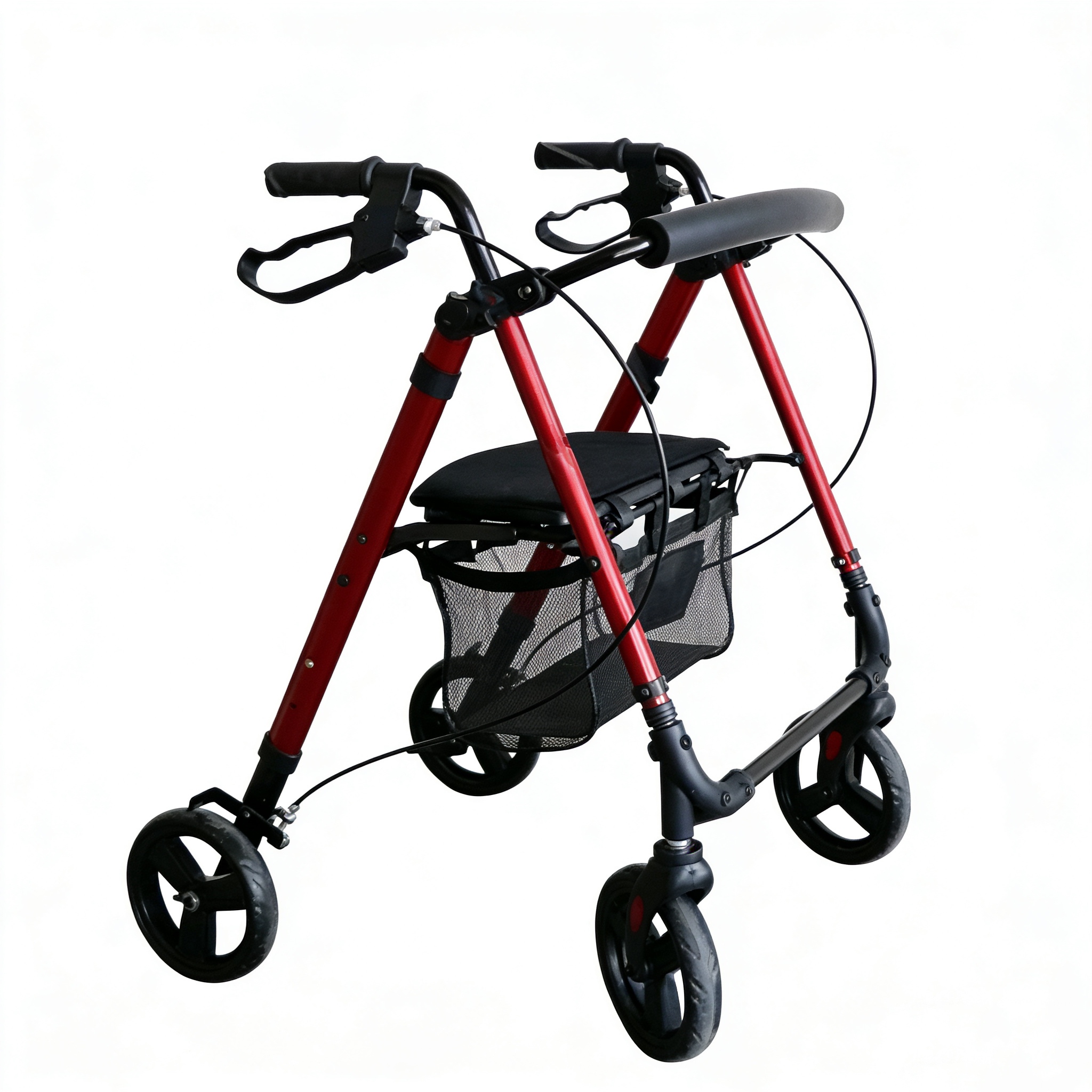
Most walking aids force your hands and hips into the same tired positions, which is why long strolls often end early. We redesigned the seat and grips to spread weight more evenly, reducing the hot spots that make you want to sit down after ten minutes.
The seat uses layered foam with a firmer outer edge and a softer center channel, so pressure shifts away from the tailbone without feeling squishy. The grips are shaped to follow the natural curve of your palm, with a slight outward flare that keeps your wrists straighter and less fatigued.
Instead of adding more padding everywhere, we focused on the exact points where pressure builds over time. The result is a walker that feels broken in on the first use, and keeps feeling that way after a few miles.
Wheels Tuned for Carpet, Tile, and Sidewalk Cracks
Most robot vacuums struggle when they hit the uneven gaps between tile and carpet, but this model doesn't flinch. The wheels were specifically designed with a wider tread pattern and softer rubber compound, letting them glide over transition strips without losing traction. On low-pile carpet, they dig in just enough to pull loose dust from the fibers, while on hard floors they leave zero scuff marks.
Sidewalk cracks are another story entirely. Instead of getting stuck in narrow grooves, the wheel suspension flexes slightly to absorb the impact and keep the vacuum moving forward. The clearance height has been tuned so that small pebbles and raised edges don't jam the axles. You'll notice the difference immediately if you've ever had to rescue a robot that got wedged between two slabs of concrete.
Tile floors, especially older ones with uneven grout lines, are where the rubber really earns its keep. The wheels maintain constant contact without bouncing, which keeps the suction nozzle at the right height. That stability means fewer missed patches and less noise from rattling components. It's a subtle engineering choice, but it's one you'll appreciate every single day.
The Shift to Aerospace-Grade Materials Without the Price Tag
For decades, alloys like 7075 aluminum and Ti-6Al-4V titanium lived almost exclusively inside wing spars and turbine housings. The price barrier wasn't the raw metal itself but the tortured path from billet to finished part: multi-axis milling, specialized heat treatment, and inspection tolerances that made a single bracket cost more than a mid-range laptop.
That math is changing. Advances in near-net-shape casting, additive manufacturing, and automated surface finishing now let smaller workshops produce aerospace-spec components without the aerospace-spec overhead. A suspension link or bicycle crank can inherit the same fatigue resistance and stiffness-to-weight ratio as a landing gear part, yet sell at a consumer-friendly price.
The shift is less about exotic chemistry and more about process discipline. By applying statistical process control and scrap-reduction loops borrowed from aviation supply chains, manufacturers are turning once-elite materials into everyday upgrades—no flight suit required.
One-Touch Braking That Feels Like Second Nature
Press the brake once and the system does the rest. No double-pumping, no guesswork—just a firm, consistent stop that feels less like an instruction and more like muscle memory. The pedal responds with a predictable bite point that mirrors the way your foot naturally expects to slow down, so every stop is smooth without that lurching hesitation common in lesser setups.
What sets this apart isn't the force, but the feedback. The mechanism dials in resistance progressively, matching the pressure you apply instead of demanding a fixed stroke. Whether it's a gentle roll to a red light or a sharp cut in traffic, the brake reads the situation and delivers exactly the right amount of grab—almost as if it learned how you drive and adjusted itself to your rhythm.
After a few days, you stop thinking about braking altogether. It fades into the background like breathing or shifting your weight on a bike. That's the real benchmark: not how powerful it feels on the first test drive, but how quickly it disappears from your conscious checklist and becomes just another automatic part of moving through the world.
Folding Flat in Seconds: Storage Solutions That Actually Work
The promise of a folding flat is that it vanishes when you don't need it. Most designs, however, leave you wrestling with latches, misaligned hinges, or a footprint that still eats up precious closet space. Real storage starts with geometry that actually collapses—think scissor-action frames that drop to under two inches, or soft-sided panels that roll instead of fold. The trick is to test the mechanism with one hand, not two: if you can't pack it away while holding a coffee cup, it's not a genuine space-saver.
Beyond the fold itself, look for pieces that do double duty. A flat-folding step stool can hang from a wall hook as a slim shelf when closed. A collapsible laundry basket with a rigid rim becomes a catch-all tray for mail in its folded state. The best storage solutions earn their keep even when collapsed, giving you a reason to leave them out rather than stuffing them behind a door. That way, the saving isn't just about the seconds it takes to fold—it's about never having to search for the thing again.
Finally, watch the materials. Cheap plastic hinges crack after a dozen folds, and thin fabric panels lose their shape fast. Opt for reinforced nylon joints, powder-coated steel frames, or thick polyester with a memory crease. A fold that feels crisp on day one should feel identical on day one hundred. When the engineering is right, flat-folding storage stops being a compromise and starts being the obvious choice for small spaces.
FAQ
They blend a sleek, almost furniture-like look with practical features like adjustable handle heights, built-in brakes, and smooth-gliding wheels that handle both indoor floors and uneven sidewalks.
The grips are contoured to reduce wrist strain, and the seat is padded with breathable fabric, so short rests feel more like sitting on a sturdy stool than a medical device.
Yes, many models include a wider base and locking rear wheels, which gives users more confidence when standing up or navigating tight corners without fearing sudden slips.
Most makers use lightweight aluminum or carbon composite tubing that keeps the walker easy to lift into a car trunk while still supporting up to 300 pounds.
Absolutely, the newer versions collapse with one hand into a compact shape that fits behind a car seat or in a narrow closet, and they often stand upright on their own.
Instead of relying on squeeze levers alone, some designs have push-down brakes that engage when you lean on the handles, plus a parking lock that keeps the walker stationary on slopes.
Yes, you can attach insulated cup holders, phone pouches, and small cargo bags that snap onto the frame without adding bulk or blocking leg movement.
Older adults recovering from surgery, people with chronic joint pain, and anyone who wants to stay active without feeling like they're pushing a medical cart around town.
Conclusion
For years, walking aids felt like obstacles—rigid frames that fought your stride, seats that turned hard after ten minutes, and wheels that jammed on the smallest threshold. The latest rollout changes that. Frames now use a slight flex in the lower tubing, so each step transfers energy instead of jarring your wrists. Grips aren't just foam cylinders; they're contoured to spread palm pressure, and the seats have layered memory foam that doesn't bottom out on longer outings. Wheel treads have been reworked with softer edges and deeper grooves, letting the same walker glide over low-pile carpet, smooth tile, and those sidewalk expansion joints that used to snag the front wheels.
What's impressive is how these improvements aren't locked behind a premium price. Manufacturers have quietly shifted to heat-treated aluminum alloys borrowed from aerospace supply chains, dropping weight by nearly a pound without giving up stiffness. Braking moved from a stiff loop you squeeze to a single paddle that responds to a light touch—your fingers learn the motion within a block or two. And when you're done, the whole thing folds flat with one hand, locking thin enough to slide behind a car seat or into a narrow closet. It's the first time a mobility device feels designed around how people actually move, stop, and store their gear.
Contact Us
Contact Person: Frank Chan
Email: [email protected]
Tel/WhatsApp: 0086-13924529088
Website: https://www.suncare-medical.com