

Swiss Type Lathe Supplier – The Key to High-Accuracy Manufacturing
2026-07-28
Precision is everything in modern manufacturing—one micron can make or break a component. Swiss type lathes have become the backbone of high-accuracy production, but finding a supplier that truly understands your needs is the real challenge. That’s where WINNRUI CNC steps in, combining cutting-edge Swiss turning technology with a commitment to reliability that keeps your operations ahead of the curve. Curious how the right partner can transform your machining floor? Let’s dive in.
Where Microns Matter: The Unseen Precision of Swiss Turning
In Swiss turning, a micron isn’t just a unit—it’s the boundary between flawless function and failure. The sliding headstock design feeds bar stock through a guide bushing, so cutting happens right at the point of support, almost eliminating deflection. This means features measured in single-digit microns—like a bone screw thread pitch or a fuel injector nozzle bore—come out repeatable, batch after batch. No floating, no vibration, just geometry locked down so tight you’d need an air gauge to spot the deviations.
What makes this precision invisible is that it’s built into the rhythm of the machine. Sub-spindle pick-off, back-working, and live tooling all happen without breaking the part’s spatial reference. When a 2 mm pin gets turned, cross-drilled, and threaded in one cycle, every transition stays within a 5-micron tolerance band—not because of a final inspection tweak, but because the Z-axis resolution and thermal-compensated ballscrews hold position before the first chip is ever made. Even coolant plays a role: precisely directed high-pressure jets whisk away chips that could otherwise ding a freshly cut surface.
Downstream, this unseen precision reshapes what’s possible. Watch components stop needing post-grinding. Dental implants seat perfectly the first time. In automated assembly, a Swiss-turned part doesn’t jam a pick-and-place head because its diameter sits at 1.998 mm, not 2.002. It’s the difference between a design that looks good in CAD and one that actually works when gravity, friction, and expansion show up. And it’s why, in Swiss turning, caring about microns isn’t overkill—it’s just the job.
Beyond Conventional Limits: How Sliding Headstocks Redefine Complexity
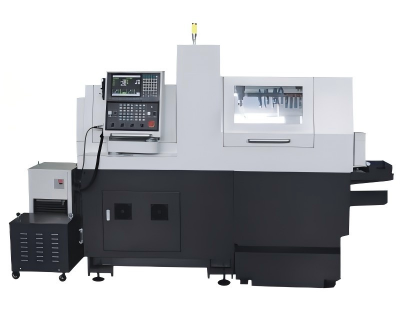
Most people assume that a lathe’s headstock is a fixed anchor, but sliding headstocks shatter that expectation entirely. Instead of the workpiece being clamped and stationary while tools move around it, the entire headstock assembly glides along the Z-axis, feeding the bar stock through a guide bush. This fundamental shift turns traditional machining logic on its head, allowing for incredibly long, slender parts to be turned with precision that conventional lathes can’t hope to match.
The real magic unfolds in how these machines handle complexity without breaking a sweat. Because the material is supported mere millimeters from the cutting tool by the guide bush, deflection becomes almost a non-issue. You can machine delicate features, deep bores, and intricate profiles in a single setup, drastically cutting cycle times. Thread whirling, polygon turning, and simultaneous back-working operations transform what would normally be a multi-machine process into a seamless ballet of synchronized axes.
Beyond just speed, sliding headstocks enable geometries that most engineers wouldn’t even attempt on fixed-headstock machines. Think of a bone screw with a complex helical flute, a tiny watch pinion with internal splines, or a hydraulic spool with ultrafine tolerances over a length-to-diameter ratio of 30:1. These aren’t just incremental improvements; they represent a completely different way of thinking about subtractive manufacturing, where the machine adapts to the part’s needs rather than forcing the part into a rigid sequence of setups.
Silent Partners in Innovation: Why Top Tier Suppliers Stand Apart
True innovation rarely happens in isolation. Behind many breakthrough products are top tier suppliers who act as quiet collaborators, weaving their expertise into a client's vision from the earliest stages. They don't just fill orders—they challenge assumptions, propose alternative materials, and refine designs long before production begins. This early engagement transforms a simple transaction into a shared creative journey.
What sets these suppliers apart is a blend of deep technical knowledge and adaptive problem-solving. They maintain advanced R&D capabilities, allowing them to experiment with novel processes and troubleshoot unforeseen obstacles without derailing timelines. Rather than sticking to rigid specifications, they iterate alongside their partners, often uncovering efficiencies that the original concept overlooked. Their agility becomes an extension of the client's own engineering team.
The result is a product that feels seamless, yet hides layers of collaborative ingenuity. Top tier suppliers leave fingerprints on everything from durability to user experience, yet their contribution remains deliberately understated. In a market flooded with generic components, this silent partnership is what elevates a good idea into a category-defining reality.
From Coils to Components: The Hidden Workflow Driving Zero-Defect Production
Every flawless product starts with raw material coiled in massive spools, but the journey from those coils to precision components involves a series of invisible processes that most never see. The hidden workflow—stretching, leveling, feeding, and stamping—operates in a carefully choreographed sequence where even a micron-level deviation can cascade into a defect. It’s not just about the machines; it’s about the system of tension control, real-time monitoring, and adaptive adjustments that eliminate variation before it becomes a problem.
At the heart of this zero-defect drive is a marriage of mechanical precision and intelligent sensing. As the coil unwinds, feedback loops constantly measure thickness, flatness, and edge position, triggering micro-corrections on the fly. The material transitions from a passive strip to a dynamically guided stream, passing through straightening rollers and servo-driven feeders that position each segment with sub-millimeter accuracy. This is where raw coil transforms into a predictable, stable input ready for the stamping die—a stage where tolerances are won or lost in fractions of a second.
The true magic happens when this entire chain—coil handling, leveling, and feeding—integrates seamlessly with the forming process. Instead of treating each step as an isolated island, a synchronized workflow uses data from one station to pre-emptively tune the next. If a coil section shows a slight hardness variation, downstream parameters adjust instantly. This closed-loop intelligence eliminates the traditional reliance on post-production inspection, baking quality into every component from the moment the material leaves the coil. It’s a hidden symphony of engineering that makes zero-defect production not just an aspiration but a daily reality.
When Speed Meets Accuracy: Untangling Throughput Myths in Micro-Machining
In the world of micro-machining, the belief that faster spindle speeds directly translate to higher throughput often overshadows the critical role of accuracy. While it’s tempting to push rotational speeds to their limits in pursuit of shorter cycle times, this approach frequently introduces thermal drift, tool deflection, and vibration that degrade part quality—forcing costly rework or scrap. True efficiency emerges not from raw speed, but from synchronizing rapid material removal with the precision needed to hold micron-level tolerances. When accuracy is sacrificed, the apparent gains in throughput are quickly erased by post-process inspection bottlenecks and the hidden expense of inconsistent output.
Breaking the myth requires rethinking how machining strategies are layered. Advanced toolpath algorithms that adapt feed rates based on real-time tool engagement allow for aggressive roughing passes without compromising the delicate finishing stages. By strategically managing chip loads and cutter paths, it becomes possible to maintain high material removal rates while preserving the geometric integrity of micro-features. The integration of high-resolution feedback systems further blurs the line between speed and precision—enabling closed-loop corrections at rates that keep pace with even the most dynamic tool motion. In this environment, throughput isn’t measured simply in millimeters per second, but in how reliably those millimeters conform to specification on the first pass.
Ultimately, the most productive micro-machining operations treat speed and accuracy as interdependent variables rather than competing priorities. Shops that have moved beyond the buzzwords invest in spindle technologies with minimized runout, temperature-stabilized machine structures, and predictive maintenance routines that prevent the gradual erosion of performance. These subtle but deliberate choices ensure that every incremental increase in cutting velocity is matched by an equivalent gain in precision. The result is a process where throughput genuinely accelerates—without the myths to slow it down.
Crafting Tomorrow's Standards: The Quiet Evolution Reshaping High-Tolerance Supply Chains
In the world of precision manufacturing, the margin between success and failure is often measured in microns. High-tolerance supply chains—those responsible for components where a hair’s breadth deviation can lead to catastrophic failure—are undergoing a silent transformation. It’s not driven by flashy announcements or sweeping regulations, but by a methodical rethinking of how standards are created, shared, and enforced. From aerospace turbines to medical implants, the old playbook of rigid specifications and punitive audits is giving way to something more dynamic, a continuous calibration of expectations shaped by real-time data and collaborative problem-solving. This is not an overnight revolution but a deliberate, almost invisible evolution that promises to redefine what "good enough" really means.
The shift is most evident in the subtle integration of digital twins and AI-driven process control, where every batch of raw material and every machine’s vibration pattern becomes part of the quality narrative. Instead of waiting for a final inspection to reveal a flaw deep inside a forged part, manufacturers now trace the entire genealogy of a component, anticipating variances before they become defects. The quiet part is that these technologies aren’t replacing human expertise but augmenting it, enabling engineers to ask better questions about acceptable risk. The supply chain is no longer a linear chain of command but a learning ecosystem where tolerances are not fixed targets but living parameters that adapt to the realities of material science, environmental conditions, and even geopolitical shifts in sourcing. It’s a profound change that’s happening in the background, often unnoticed by those outside the factory floor, yet it’s already shaping the reliability of the products we depend on daily.
Perhaps the most radical element of this quiet evolution is its impact on relationships. The old adversarial model, where buyers squeezed suppliers on cost while demanding absolute compliance, is being replaced by a form of shared destiny. Long-term partnerships are now built around mutual investment in capability, with transparency replacing the blame game. When a batch of titanium alloy arrives with a slight but still specification-compliant hardness variation, the conversation isn’t about rejection but about optimization—how to tweak the next production run so both sides benefit. This cultural overhaul, driven more by necessity than by altruism, is forging standards that are not just technical documents but living agreements. They are crafted not in committee rooms but through the daily exchange of insights, turning the supply chain into a resilient network that learns faster than any single entity ever could. Tomorrow's standards are being written today, not in ink, but in the data trails left by every successful—and failed—iteration.
FAQ
A Swiss type lathe is a precision machining tool that feeds the workpiece through a guide bushing, offering exceptional support close to the cutting point. This design drastically reduces vibration and deflection, enabling tight tolerances and smooth finishes on small, complex parts.
Unlike a conventional lathe where the part is clamped and the tool moves along a fixed length, a Swiss lathe feeds the bar stock continuously through a collet and guide bushing. The tool cuts right next to the support, so the material doesn’t flex—ideal for long, slender components.
Medical device makers, watch manufacturers, aerospace component producers, and electronics companies all depend on Swiss lathes. Anything requiring micro-sized, high-precision turned parts—like bone screws, watch pinions, or fiber optic ferrules—is a perfect match.
Look for a supplier that doesn’t just sell machines but offers thorough application engineering, responsive service, and training. They should understand your material and tolerance requirements, and have a track record of keeping uptime high and scrap low.
The right supplier ensures you get a lathe configured for your specific parts, not just a stock model. They help with tooling layouts, process optimization, and thermal stability practices that directly impact part consistency and accuracy from the first batch onward.
Common issues include poor surface finish due to improper guide bushing adjustment, chatter from suboptimal tooling selection, and rapid tool wear from incorrect speeds and feeds. A knowledgeable supplier provides setup guidance and ongoing troubleshooting to mitigate these problems before they affect production.
Conclusion
Swiss type lathes have become the quiet backbone of high-accuracy manufacturing, delivering precision where conventional CNC machines simply cannot reach. At scales measured in microns, the sliding headstock design fundamentally changes the game, guiding bar stock past a fixed tool zone so that deflection is all but eliminated. This single architectural difference allows shops to turn parts with length-to-diameter ratios that would cause chatter and scrap on a traditional lathe—medical bone screws, micro-electronic pins, and watch components emerge with surface finishes and tolerances that speak less of machining and more of grinding. It is in this unseen world of Swiss turning that complexity becomes routine: cross-drilling, off-center milling, and delicate threading happen in one handling, slashing cycle times while guarding positional accuracies that human hands could never match.
Yet having the best Swiss machinery means little without a supplier who functions as a true engineering partner. Top-tier suppliers do not merely stock and ship lathes; they embed themselves in the customer’s workflow, analyzing everything from bar feed consistency to chip evacuation strategies. They grasp that zero-defect production is not a result of flawless machines alone but of a seamless coil-to-component ecosystem—where guide bush settings, high-pressure coolant delivery, and in-process metrology converge. These silent partners help untangle the myths around micro-machining throughput, showing that speed is a meaningless metric if it sacrifices process stability. Instead, they tune the entire cell so that high-speed spindles and simultaneous backworking translate into actual, repeatable output. In an era where supply chains are tightening tolerances across aerospace, medical, and automotive sectors, such suppliers are quietly advancing tomorrow’s standards. They curate training, retrofit older equipment for lights-out runs, and constantly refine tooling setups—not because a catalog tells them to, but because they understand that in high-tolerance manufacturing, sustained accuracy is the only currency that matters.
Contact Us
Contact Person: Tim
Email: [email protected]
Tel/WhatsApp: +86 15522553731
Website: https://www.winnrui-cnc.com/